College Station sits in the Post Oak Savannah
The natural landscape around College Station is not dense East Texas pine forest and it is not open Hill Country scrub. It is part of the Post Oak Savannah, a broad transition zone where oak woodland and prairie meet. Texas Parks & Wildlife describes post oak and blackjack oak as signature trees of the region, with cedar elm, sugarberry, pecan, southern red oak, bur oak, water oak, loblolly pine, and other species appearing across suitable sites.
That matters for tree service because species, soil, and stress interact. A post oak on a sandy upland site can respond differently from a water oak in a wetter low area. A live oak in an irrigated subdivision can have different rooting and pruning problems than a native blackjack oak on rural acreage. Identifying the tree and the site is more useful than applying one rule to every trunk.
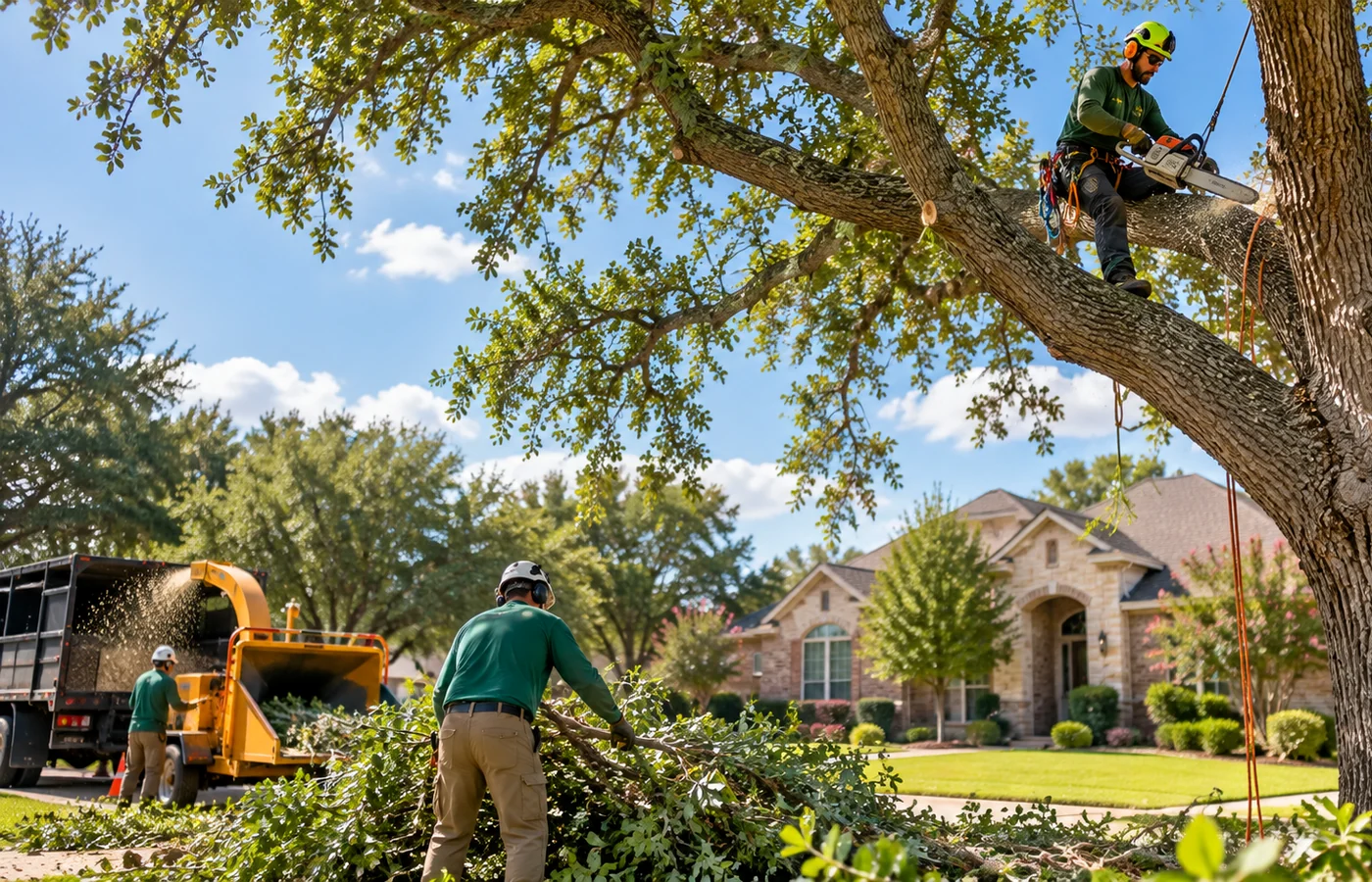
Common trees property owners see around the Brazos Valley
Post oak and blackjack oak are foundational Post Oak Savannah species. They are often associated with drier upland soils and can be sensitive to major root disturbance or drastic changes in grade and drainage. Mature native oaks are valuable shade trees, but decline can be difficult to reverse once root systems are badly damaged.
Live oak is widely planted and also occurs naturally in parts of the region. Large spreading crowns can create roof, driveway, and street-clearance needs. Live oaks are also important in oak-wilt management because interconnected root systems can allow the disease to move between nearby trees.
Cedar elm, American elm, pecan, bur oak, Shumard red oak, water oak, willow oak, bald cypress, and sycamore are among the canopy trees College Station lists as suitable for local landscape use under appropriate conditions. Different species tolerate drought, wet soil, restricted rooting areas, and urban heat differently, so planting and pruning decisions should be site-specific.
Heat and drought can create problems years later
Texas A&M Forest Service explains that severe drought can kill fine feeder roots and leave a tree under stress long after soil moisture improves. That is one reason a tree may thin out, shed limbs, or decline a season or two after the driest weather has passed.
Drought-stressed trees are also more vulnerable to secondary problems. Borers, root rots, and canker-causing organisms can become more damaging when a tree is already weakened. The right response may be watering, deadwood pruning, monitoring, diagnosis, or removal depending on the species and the amount of living crown that remains.
Oak wilt changes the pruning calendar
Oak wilt is one of the most destructive oak diseases in Texas. Texas A&M Forest Service recommends avoiding pruning or wounding oaks from February through June, when sap-feeding beetles are active and new infections are more likely. Fresh oak wounds should be painted immediately at any time of year.
Storms do not follow the calendar, of course. If a broken oak limb must be removed for safety, the cut may still need to be made. The key local practice is to protect the fresh wound rather than delaying a necessary emergency correction.
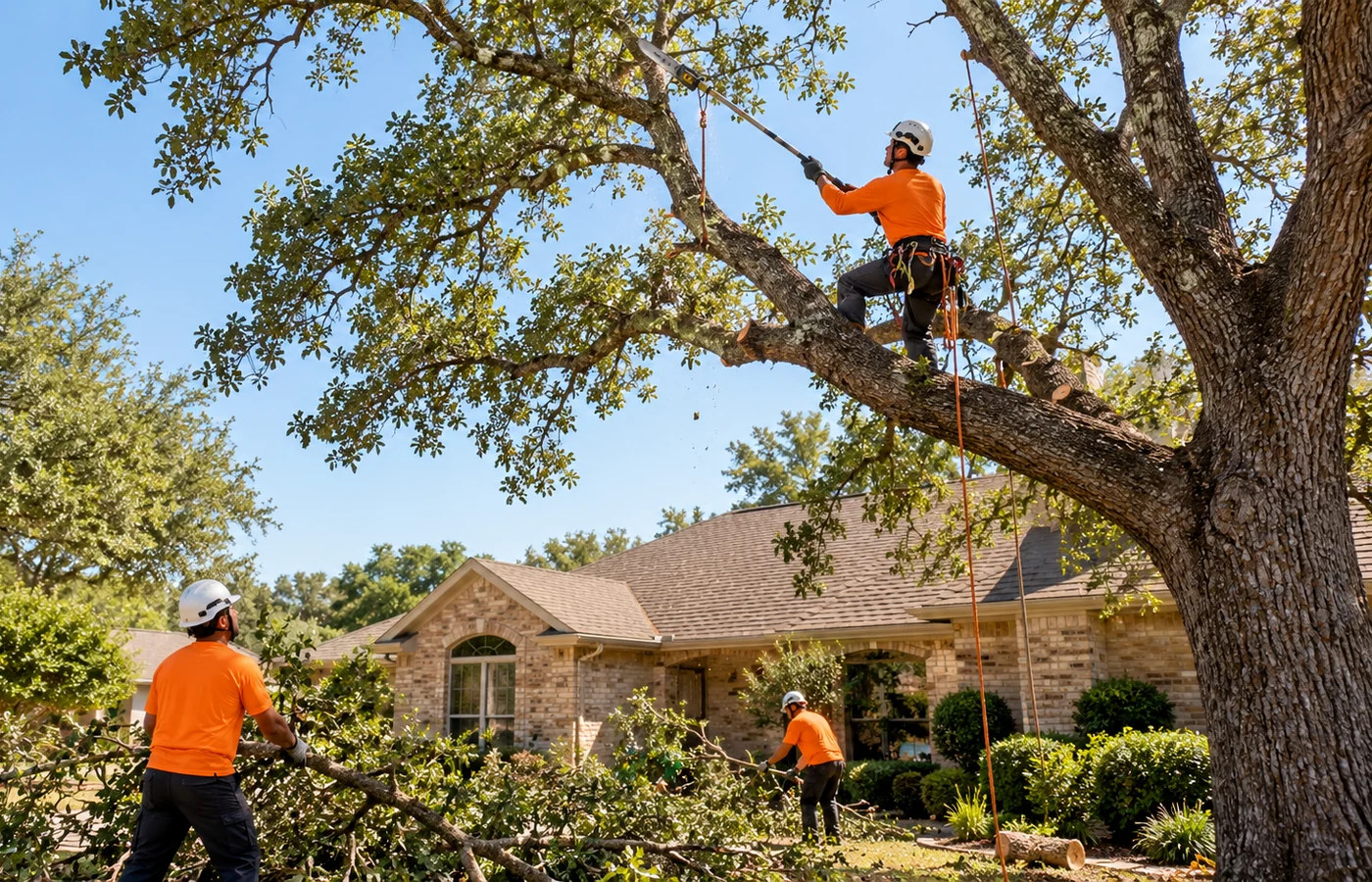
Thunderstorms, wind, lightning, and ice create different damage patterns
Wind can snap weak branches, open codominant stems, or partially uproot trees. Lightning can damage trunk tissue and roots even when the tree remains standing. Ice and freeze events commonly cause branch loss, and Texas A&M Forest Service notes that some freeze damage is easier to judge after spring growth begins.
After a storm, the first question is safety. Trees on structures, hanging limbs, split trunks, and trees involved with power lines need priority attention. Trees that simply look sparse or ragged may still recover and should not automatically be removed without evaluating the remaining structure and live crown.
Soils change across surprisingly short distances
Texas Parks & Wildlife describes Post Oak Savannah uplands as commonly sandy or sandy loam, with heavier clay and clay-loam soils in bottomlands. Lake Somerville's surrounding landscape includes post oak, hickory, blackjack oak, water oak, and yaupon woodland. Those soil and vegetation changes influence drainage, rooting depth, drought response, and equipment access.
For tree work, soil also affects the work zone. Heavy equipment can rut soft ground or compact wet soil. Stump grinding can mix chips with clay or sandy soil differently. New trees should be matched to drainage and rooting space rather than chosen only by appearance.
Construction and root-zone damage are easy to miss
Trenching, driveway work, grade changes, construction traffic, and repeated equipment travel can injure roots without leaving an obvious wound on the trunk. Root loss can later show up as canopy thinning, dieback, reduced anchorage, or decline during drought.
On remodels, additions, pool projects, and new construction, protecting the root zone before heavy equipment arrives is much easier than trying to repair the damage after the fact. If a mature tree is intended to remain, tree protection should be part of site planning.
Cleanup rules can change the estimate
College Station allows household brush under its collection rules, but specifically prohibits contractor-generated waste from that program. That distinction matters after pruning, removal, and storm cleanup. A professional scope should say whether brush is chipped, logs are hauled or left, stump grindings are removed or backfilled, and final cleanup is included.
Commercial properties have an even clearer disposal issue: College Station states that commercial entities do not receive routed weekly bulk or brush collection and brush is prohibited from city-issued commercial containers.
When to request an estimate
Request an evaluation when you see dead major limbs, cracks at large unions, a new lean with soil movement, mushrooms or decay at the base, repeated branch failures, canopy dieback, a tree on a structure, storm-broken limbs, or a tree that has outgrown the available space. Photos of the full tree, trunk base, canopy, nearby structures, and access route can make the first estimate conversation much more useful.