College Station and Bryan are the primary service area, with the shortest travel, the largest concentration of properties, and the strongest fit for routine scheduling.
Coverage centers on College Station and Bryan, with scheduled service to nearby Brazos Valley communities that remain practical for a tree crew and its equipment.
Most scheduled work stays within roughly 30 driving miles of College Station. Anderson and Franklin can also be practical for larger or well-planned jobs when route, equipment, and scheduling line up.
College Station and Bryan are the core service markets. The other communities listed here are recognizable nearby places where planned tree work can still fit normal routing and equipment logistics.
If the property is just outside a listed community, submit the address or call. Serviceability depends on the actual drive, job size, equipment needs, and current schedule.
Send the job details online or call (979) 978-0490. Include the city, the number of trees, the problem you are seeing, and any access or structure concerns you already know about.
College Station and Bryan form the core of the service area. Nearby communities are scheduled when travel time, project size, and equipment needs make the trip practical.
The service footprint is based on real driving and mobilization, not a straight-line radius. Longer-drive requests are more likely to make sense when several trees or related tasks can be handled in one visit.
College Station and Bryan are the primary service area, with the shortest travel, the largest concentration of properties, and the strongest fit for routine scheduling.
Navasota, Caldwell, Hearne, Somerville, Snook, Kurten, and Millican remain within the practical regional footprint for planned tree work.
Anderson and Franklin can still be practical, especially for larger projects or multiple-tree scopes. Requests farther away are considered case by case.

A property can be close in mileage and still be complicated to serve. Narrow gates, long unpaved drives, soft ground, septic areas, steep drainage cuts, traffic constraints, limited parking, and trees far from equipment access all affect the job. Rural acreage can have plenty of room around the tree but poor access for a chip truck or lift. Suburban lots can have excellent road access but tight work zones around roofs, fences, pools, and neighboring property.
When requesting service outside College Station, include the exact city and ZIP plus any access details you already know. Photos that show the whole tree and the route from street or driveway to the work area can be especially useful.
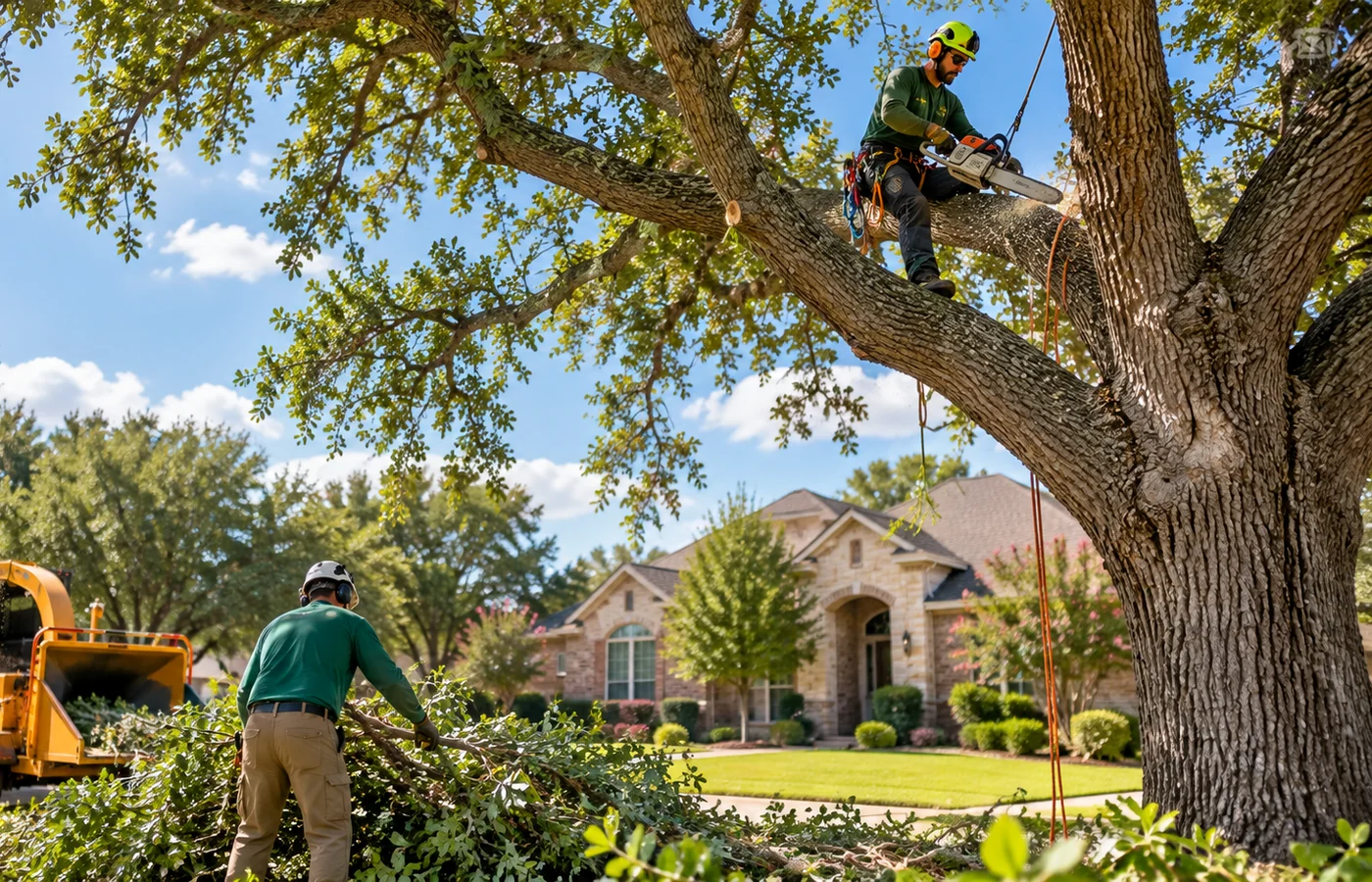
Tree service involves trucks, trailers, chippers, grinders, climbing gear, and often a significant amount of debris. Travel time and mobilization therefore matter. The communities listed here are close enough to College Station to remain practical for scheduled work under the right project conditions.
Properties outside the College Station/Bryan core often have larger lots, acreage, gravel drives, gates, livestock areas, septic systems, or trees located far from paved access. More open space can make felling easier, but long equipment routes and soft ground can create a different kind of challenge. Mention those conditions up front.
In the denser parts of College Station and Bryan, the opposite problem is common: excellent street access but small work zones around roofs, fences, driveways, utility drops, neighboring trees, and landscaping. Controlled rigging and careful debris staging can matter more than travel distance.