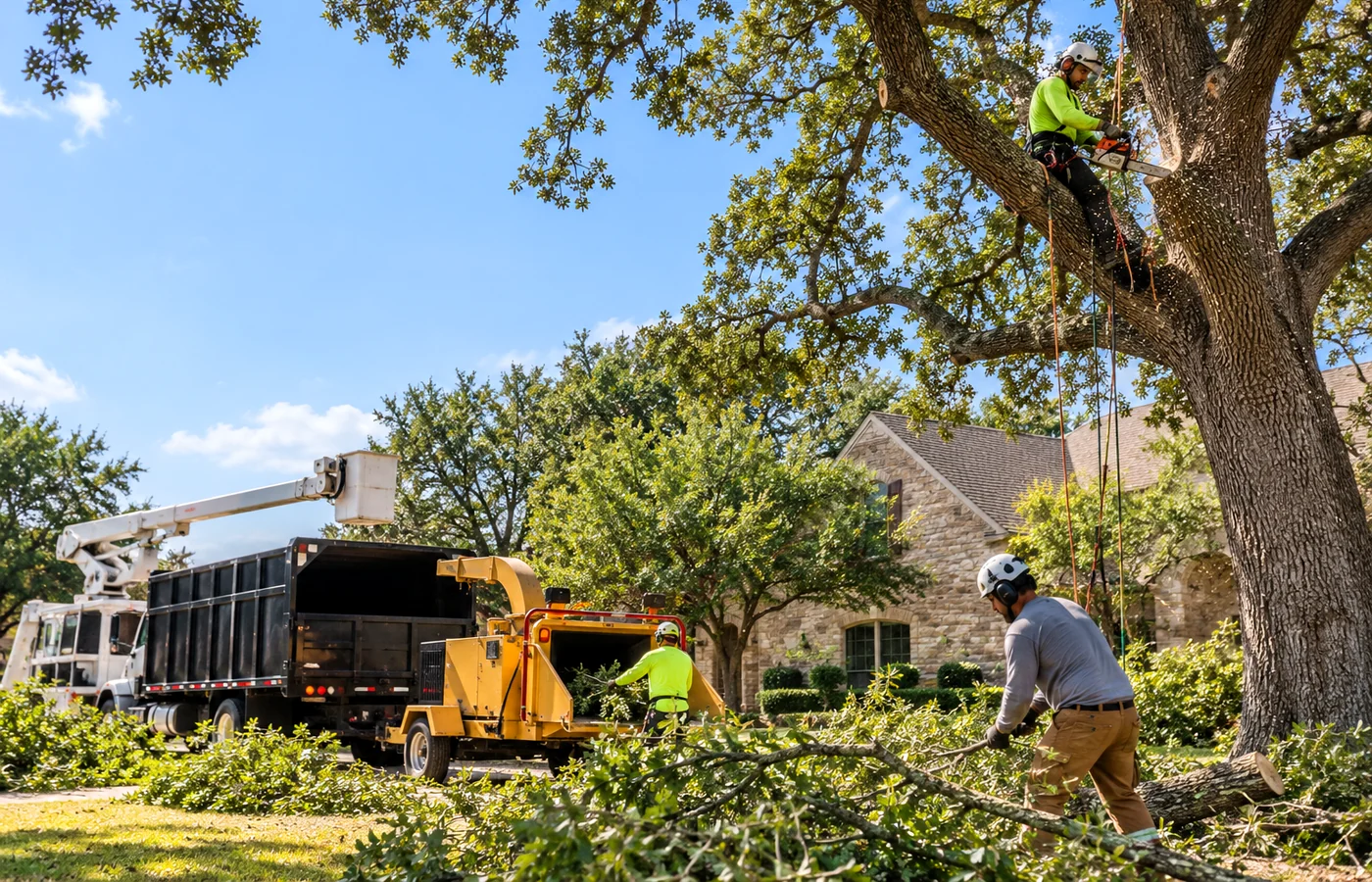
When emergency tree service becomes the right next step
Thunderstorms, strong wind, saturated soil, heat stress, and occasional ice can create very different failure patterns. A broken limb hanging over a drive is not the same problem as a whole tree uprooted onto a roof. The first goal is to keep people clear of the hazard and determine what can be stabilized or removed safely. Work involving downed or contacted power lines should begin with the utility or emergency authorities, not private cutting.
The useful starting point is the problem, not the tool. A property owner may notice a leaning trunk, broken limb, crowded crown, leftover stump, clearance conflict, or storm debris. Those observations help define the job, but the final scope should account for the entire work zone. A tree can be healthy yet poorly placed. Another can look full and green while a weak union, decay pocket, root movement, or old storm injury changes the risk picture. Good planning means deciding what result the property needs and then choosing the least disruptive way to get there.
For emergency tree service in College Station, the estimate should be specific enough that two people reading it would understand the same job. That means identifying the tree or area, the main objective, the debris plan, stump or root work when relevant, and notable access limitations. Vague phrases such as “trim trees” or “remove oak” can hide major differences in workload. A clearly described scope makes it easier to compare bids and reduces surprises once work starts.
Common reasons property owners request this service
Most calls begin with a practical concern. The tree is doing something the owner cannot safely or efficiently solve from the ground, or the tree has become part of a larger property project. Typical situations include:
- a tree or major limb has fallen on a structure, fence, driveway, or access route
- large broken limbs remain suspended in the crown
- a trunk split or root plate shifted after wind or saturated soil
- storm damage created an unstable tree near occupied areas
- debris is blocking safe access to a home or property
Some requests are elective and can be scheduled around weather, season, and other landscape work. Others are more time-sensitive because people, vehicles, structures, or access routes are exposed. If a tree is in contact with electrical conductors or utility equipment, stay clear and contact the utility or emergency authorities before private tree work begins.
What changes the scope and price
Tree work is unusually site-dependent. Two trees of the same species and similar height can require very different plans if one stands in an open yard and the other is boxed in by a house, fence, pool, and service line. The estimate should consider the physical tree, the targets around it, and how crews and equipment can reach the work.
whether people can safely stay away from the hazard
contact with electrical lines or utility equipment
tree position and remaining stored tension in broken wood
access for crews and equipment after a storm
priority work needed to make the site safer before full cleanup
debris volume and whether follow-up pruning or stump work is needed
Debris handling also deserves its own line of thought. Ask what happens to brush, logs, chips, and stump grindings. College Station's household brush program has specific rules and excludes contractor-generated waste, so professional tree debris should not automatically be assumed to qualify for ordinary curbside pickup. When hauling matters, put it in writing.
How the work is usually planned
Before the work date, clear movable objects from the access path and work zone. Vehicles, trailers, patio furniture, grills, toys, hoses, decorative lighting, and portable planters are easy to relocate and can give crews more room. If there are irrigation lines, septic components, invisible dog fences, landscape lighting wires, or owner-installed utilities, point them out during the estimate because they may not appear on public utility markings.
Tree work around structures, fences, and utilities
Many College Station tree jobs happen in developed yards where the tree is only a few feet from something expensive. Controlled work may involve cutting material into smaller pieces, using ropes to guide or lower sections, protecting turf or paving, and staging debris so the crew does not repeatedly cross finished areas. The right technique depends on the tree and site; the important homeowner question is whether the estimate recognizes the constraints.
Utility conflicts deserve extra caution. Trees growing near service drops or distribution lines can create hazards that are not solved by ordinary trimming. Owners should never assume a private crew can safely work around energized conductors. When public right-of-way is involved, municipal requirements may also apply. Bryan, for example, lists tree trimming among activities that can require right-of-way permitting when work occupies or affects city right-of-way.
Emergency tree work in the Brazos Valley often starts with weather damage
Strong thunderstorms, straight-line winds, lightning, and occasional ice or hard-freeze events can leave broken tops, hanging limbs, split trunks, and partially uprooted trees across College Station and Bryan. Texas A&M Forest Service emphasizes safety first after storms because damaged trees can remain unstable even when the worst weather has passed.
If a tree or limb is touching a power line, stay clear and contact the electric utility or emergency authorities. Do not pull, cut, climb, or handle the tree. A tree can conduct electricity even when the line is difficult to see.
Oak damage deserves one extra local step. Texas A&M Forest Service recommends painting fresh oak wounds immediately, including wounds created during storm cleanup, and avoiding unnecessary oak pruning from February through June. Emergency cuts may still be necessary for safety, but wound protection should not be skipped.
College Station does not accept contractor-generated debris through normal household brush collection, so emergency work should include a clear haul-off or debris plan. Large storm jobs can produce far more material than a normal curbside pile.
What to ask before approving an estimate
Confirm the exact trees included, the work objective for each tree, whether debris is hauled, whether stump work is included, and what happens if hidden decay or another condition changes the planned method. Ask how access will be protected and whether gates, fences, or irrigation create limitations. For higher-risk or specialized work, ask about the provider's insurance and relevant qualifications before the job starts. Those questions are useful whether the project is a single small tree or a multi-tree commercial scope.
Also decide what “finished” means for your property. Some owners want every log and chip removed. Others keep firewood, mulch chips, or stump grindings. Some want only the immediate hazard addressed and plan cosmetic pruning later. A written scope should reflect those preferences rather than forcing every job into one cleanup package.
Related tree services

Tree Removal
Controlled removal for dead, declining, storm-damaged, crowded, or unwanted trees.
Learn about tree removal →
Tree Trimming & Pruning
Pruning for clearance, structure, deadwood, storm damage, and healthier long-term growth.
Learn about tree trimming & pruning →
Stump Grinding
Stump reduction for cleaner yards, easier mowing, replanting, and construction clearance.
Learn about stump grinding →Frequently asked questions
What counts as a tree emergency?
A fallen tree, suspended large limb, split trunk, shifted root plate, blocked access, or tree damage threatening an occupied area can justify urgent attention.
What if the tree is touching a power line?
Stay away and contact the electric utility or emergency authorities. Do not approach, cut, pull, or climb a tree involved with energized lines.
Should I cut storm-damaged limbs myself?
Small ground-level cleanup may be manageable, but suspended limbs, loaded branches, large trunks, and chainsaw work around structures can behave unpredictably.
Will emergency work include full cleanup?
Not necessarily. The first scope may focus on making the situation safer or reopening access. Full debris removal, pruning, or stump grinding should be clarified in the estimate.
Can a storm-damaged tree be saved?
Sometimes. The answer depends on trunk integrity, root stability, crown loss, species, remaining structure, and what targets are nearby.
What should I photograph for an estimate?
Wide shots showing the whole tree and nearby structures are useful, plus closer photos of splits, uprooting, broken leaders, or impact areas taken only from a safe location.