Brazos Valley tree-care planning
Useful local issues to know before the saw starts
College Station lies in the Post Oak Savannah, a transition landscape of oak woodland and grassland. Texas Parks & Wildlife identifies post oak and blackjack oak as signature trees, with cedar elm, sugarberry, pecan, southern red oak, bur oak, water oak, loblolly pine, and other species also occurring across the region. That tree mix helps explain why oak disease, drought stress, storm damage, and mature-canopy pruning are recurring local tree-care topics.
Oak wilt and pruning seasonTexas A&M Forest Service recommends avoiding pruning or wounding oaks from February through June because that period carries elevated oak wilt risk. Fresh oak wounds should be painted immediately regardless of season.
Heat and drought stressDrought can kill feeder roots and leave trees stressed for years. That prolonged stress can increase vulnerability to borers, root rots, and cankers even after rainfall returns.
Storm and freeze damageThunderstorm wind, lightning, and occasional ice or hard freezes can create branch loss, split unions, hanging limbs, and delayed canopy dieback.
Root-zone damageConstruction traffic, trenching, grade changes, compaction, and repeated equipment travel can injure roots even when the trunk looks untouched.
Debris and disposalCollege Station prohibits contractor-generated waste in the normal household brush program, so a professional tree-work scope should address the debris plan directly.
Right-of-way work in BryanBryan lists tree trimming among Type A right-of-way permit activities when work affects public right-of-way.
Oak wilt and pruning seasonTexas A&M Forest Service recommends avoiding pruning or wounding oaks from February through June because that period carries elevated oak wilt risk. Fresh oak wounds should be painted immediately regardless of season.
Storm damage versus routine pruningA hanging limb, split trunk, uprooting root plate, or tree on a structure is an immediate hazard issue. Ordinary deadwood or clearance pruning can usually be scheduled as planned maintenance instead.
Heat and drought stressLeaf scorch, sparse canopy, premature leaf drop, and twig dieback can show up after prolonged heat or dry periods. Those symptoms do not automatically mean removal is necessary, but they are useful context for an on-site assessment.
Freeze injuryCentral Texas freeze events can break limbs or kill portions of a canopy. Some damage is immediately obvious while other decline becomes clearer over the following growing period.
Root-zone damageConstruction traffic, trenching, grade changes, compaction, and repeated equipment travel can injure roots even when the trunk looks untouched. Protecting the root zone matters during both tree work and unrelated property projects.
Debris and disposalCollege Station prohibits contractor-generated waste in the normal household brush program, so a professional tree-work scope should address the debris plan directly.
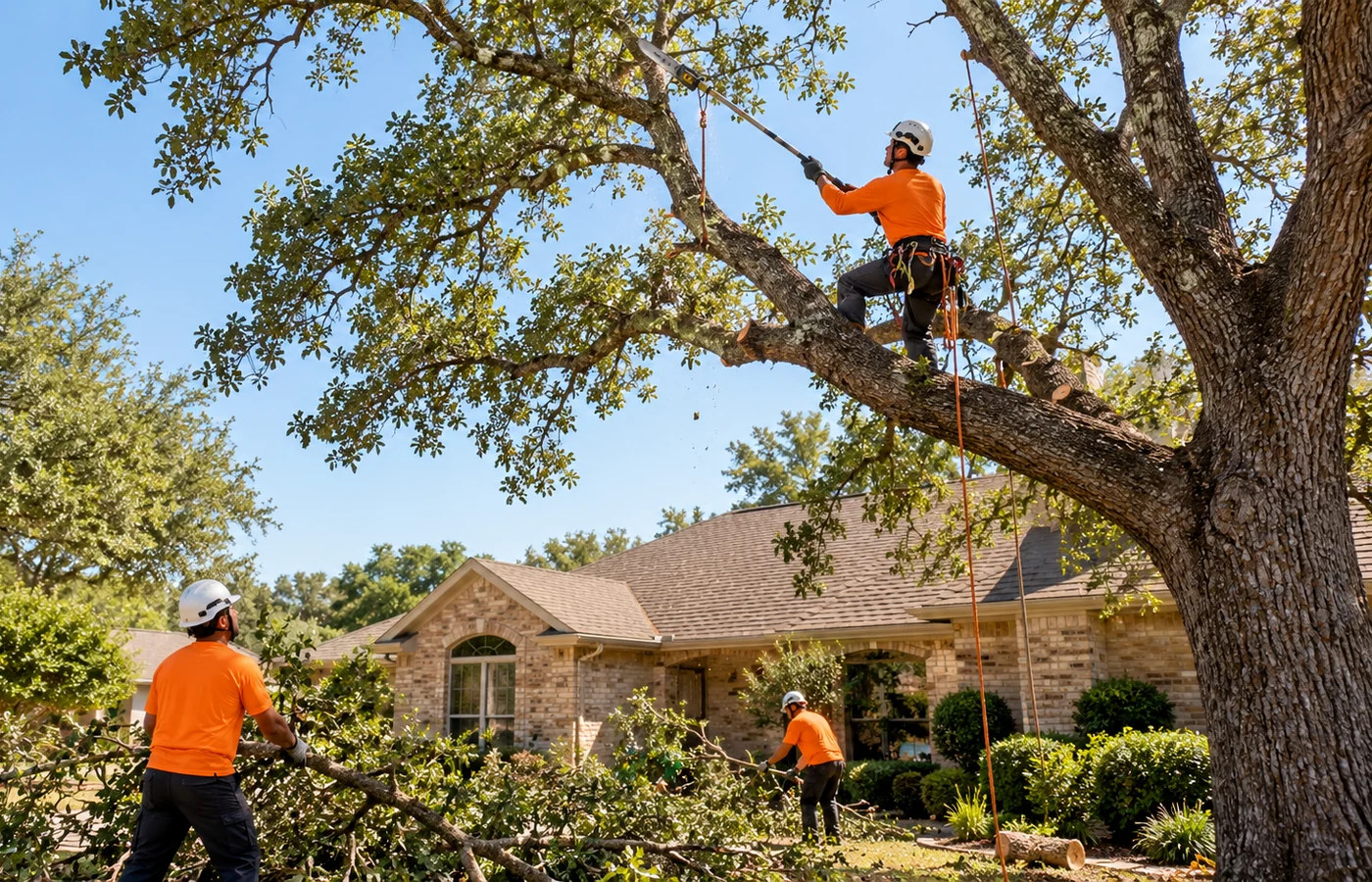
When a tree needs a specialist rather than ordinary cutting
Some requests are straightforward production tree work. Others involve diagnosis, risk evaluation, pest or disease treatment, structural support, or a high-value tree where the goal is preservation. If the main question is “Is this tree safe?” or “What disease is this?” rather than “Can you trim or remove it?”, ask whether the assigned provider has the appropriate arboriculture training and credentials for that decision.
Cabling and bracing is another example. Hardware can sometimes support a tree with a structural weakness, but installing support without understanding the defect, load, and inspection needs can create a false sense of security. A qualified evaluation should come before hardware.
Photos that make an estimate request more useful
Take one photo from far enough away to show the entire tree and its relationship to the house, street, fence, or neighboring property. Add closer photos of the trunk base, visible cracks, broken limbs, cavities, mushrooms, decay, or storm damage. If access is tight, photograph the gate, side yard, driveway, and any overhead lines. For stump work, include a photo with a common object nearby for scale and note whether the area needs to be replanted, sodded, or built over.
Good photos do not replace an on-site assessment, but they make triage easier and help the provider arrive with a clearer idea of the equipment, crew, and time the property may require.