
Tree Removal
Controlled removal for dead, declining, storm-damaged, crowded, or unwanted trees.
Learn about tree removal →Explore the main tree-service scopes available across College Station and nearby Brazos Valley communities.
Use the individual pages to understand the work, access considerations, debris decisions, and questions worth asking before approving an estimate.
Controlled removal for dead, declining, storm-damaged, crowded, or unwanted trees.
Learn about tree removal →
Pruning for clearance, structure, deadwood, storm damage, and healthier long-term growth.
Learn about tree trimming & pruning →
Stump reduction for cleaner yards, easier mowing, replanting, and construction clearance.
Learn about stump grinding →
Urgent help for fallen trees, hanging limbs, blocked access, and storm-created tree hazards.
Learn about emergency tree service →
Post-storm removal of broken limbs, downed tree material, and damaged tree debris.
Learn about storm damage tree cleanup →
Tree work for offices, multifamily properties, retail sites, institutions, and managed properties.
Learn about commercial tree service →
Planning and installation for replacement trees, new shade, screening, and long-term landscape structure.
Learn about tree planting →
Supplemental support options for selected weak unions, heavy limbs, and structurally important trees.
Learn about tree cabling & bracing →Describe what you see rather than trying to diagnose the tree yourself. Tell us whether the issue is a dead tree, broken limb, leaning trunk, clearance problem, leftover stump, storm debris, or another concern. Photos and basic access notes can help define the next step.
Some projects legitimately include more than one service. A removal may be followed by stump grinding. Storm cleanup may reveal pruning needs in nearby standing trees. A commercial property may combine clearance pruning, removals, and phased maintenance.
Tell us what is happening on the property and how to reach you.
Send the job details online or call (979) 978-0490. Include the city, the number of trees, the problem you are seeing, and any access or structure concerns you already know about.
Post oak, blackjack oak, live oak, cedar elm, pecan, water oak, and other shade trees are part of the College Station-area landscape. Heat and drought can produce decline and deadwood. Thunderstorms and ice can create broken limbs and structural damage. Oak wilt affects pruning timing. Construction and compaction can damage roots even when the canopy still looks normal.
That is why the service architecture is organized around real work types rather than keyword synonyms. Removal, pruning, stump grinding, storm cleanup, planting, commercial work, and structural support each involve different equipment, decisions, pricing drivers, and cleanup needs.
Common trees & problems in the Brazos Valley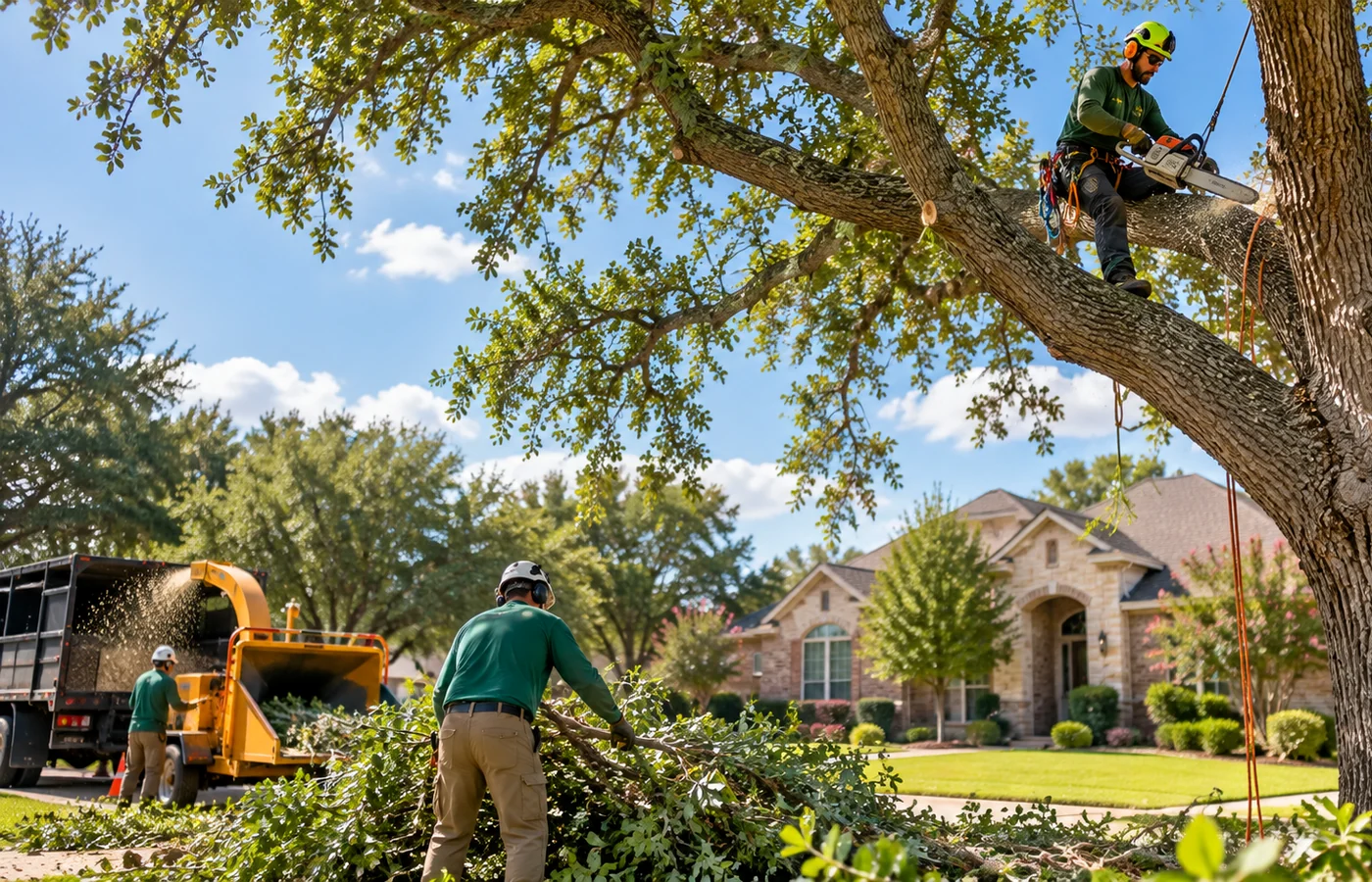
Homeowners often know what is wrong before they know the exact service name. Use the situation below to find the most likely starting point, then let the property conditions determine the final scope.
Start with tree removal. Dead tree removal, hazardous removal, and tree cutting generally live under the same core service intent.
Start with trimming and pruning for deadwood, roof or driveway clearance, structure, storm damage, or canopy management.
Start with stump grinding. Tell the estimator whether you plan to replant, build, sod, or simply reduce the stump below grade.
Use emergency tree service when there is an active hazard or blocked access. Use storm cleanup when the immediate hazard is controlled and the remaining job is cutting, hauling, and cleanup.
Commercial tree service fits HOAs, rentals, multifamily, retail, offices, churches, and managed properties where scheduling and site coordination matter as much as the cutting.
Tree planting and cabling/bracing are preservation-oriented services. Species choice, planting depth, site conditions, and structural suitability matter more than a generic one-size-fits-all approach.
Budget question? The cost guide gives College Station planning ranges for removal, trimming, stump grinding, debris hauling, and the factors that make technical jobs more expensive.
See costs & pricingTwo jobs can both be called “tree trimming” and still require completely different equipment and crew time. A small front-yard tree with ground access may be straightforward. A mature oak over a roof may require climbing, controlled lowering, protection for landscaping, and significantly more cleanup. The same is true of removal, stump work, and storm cleanup.
Access is one of the biggest variables. Tell the estimator about gate width, fences, retaining walls, soft ground, septic components, low overhead lines, steep drainage, pools, sheds, parked vehicles, or neighboring property that limits the work zone. If a lift or loader cannot reach the tree, the job may need more climbing and manual handling.
Cleanup is another major scope choice. Some owners want every limb, log, and chip hauled away. Others want firewood-length logs stacked, chips left for mulch, or grindings left in the stump hole. Make that preference part of the estimate instead of assuming one cleanup standard.
Ask each provider to quote the same requested outcome. If one estimate includes stump grinding, full haul-off, and extensive deadwood removal while another covers only dropping the tree, the numbers are not comparable. A useful quote identifies the trees, the work on each tree, cleanup, stump scope, and major access or equipment assumptions.
For preservation-oriented work, the service name also matters. Tree planting is not only digging a hole and setting a root ball. Species selection, mature size, drainage, planting depth, root flare, staking, and irrigation all affect whether the tree establishes well. Cabling and bracing should be based on an actual structural need rather than used as a generic add-on.
Compare the situations that point toward preservation versus full removal.
Use Texas-specific oak wilt timing and fresh-wound guidance.
Separate immediate hazards from ordinary cleanup and debris work.
See local planning ranges before requesting a property-specific estimate.