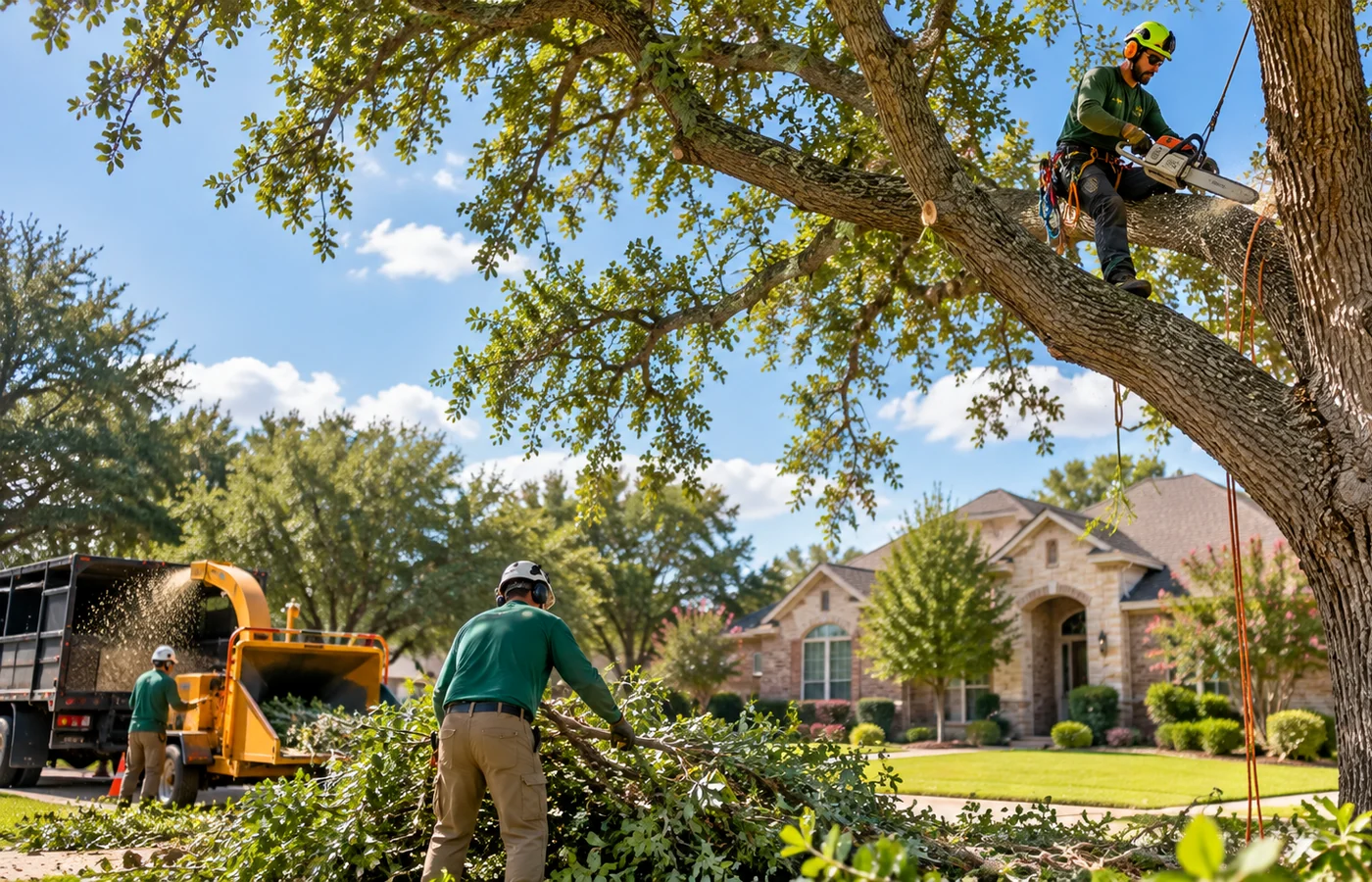
When commercial tree service becomes the right next step
Commercial tree work in College Station can range from a single storefront tree to apartment communities, offices, schools, churches, and larger managed properties. The tree work itself is only part of the plan. Equipment staging, parking access, pedestrian movement, tenant communication, and debris handling can determine when and how the job should be performed.
The useful starting point is the problem, not the tool. A property owner may notice a leaning trunk, broken limb, crowded crown, leftover stump, clearance conflict, or storm debris. Those observations help define the job, but the final scope should account for the entire work zone. A tree can be healthy yet poorly placed. Another can look full and green while a weak union, decay pocket, root movement, or old storm injury changes the risk picture. Good planning means deciding what result the property needs and then choosing the least disruptive way to get there.
For commercial tree service in College Station, the estimate should be specific enough that two people reading it would understand the same job. That means identifying the tree or area, the main objective, the debris plan, stump or root work when relevant, and notable access limitations. Vague phrases such as “trim trees” or “remove oak” can hide major differences in workload. A clearly described scope makes it easier to compare bids and reduces surprises once work starts.
Common reasons property owners request this service
Most calls begin with a practical concern. The tree is doing something the owner cannot safely or efficiently solve from the ground, or the tree has become part of a larger property project. Typical situations include:
- limbs interfering with parking, signs, roofs, lighting, sidewalks, or service lanes
- deadwood over high-traffic pedestrian and vehicle areas
- trees obscuring visibility at entrances or internal drives
- storm damage requiring coordinated cleanup across a larger property
- recurring pruning needs on multifamily or managed landscapes
Some requests are elective and can be scheduled around weather, season, and other landscape work. Others are more time-sensitive because people, vehicles, structures, or access routes are exposed. If a tree is in contact with electrical conductors or utility equipment, stay clear and contact the utility or emergency authorities before private tree work begins.
What changes the scope and price
Tree work is unusually site-dependent. Two trees of the same species and similar height can require very different plans if one stands in an open yard and the other is boxed in by a house, fence, pool, and service line. The estimate should consider the physical tree, the targets around it, and how crews and equipment can reach the work.
site access and work-hour restrictions
traffic and pedestrian control around the work zone
parking-lot occupancy and equipment staging
debris hauling requirements
coordination with property managers, tenants, or facility staff
repeat service priorities versus one-time corrective work
Debris handling also deserves its own line of thought. Ask what happens to brush, logs, chips, and stump grindings. College Station's household brush program has specific rules and excludes contractor-generated waste, so professional tree debris should not automatically be assumed to qualify for ordinary curbside pickup. When hauling matters, put it in writing.
How the work is usually planned
Before the work date, clear movable objects from the access path and work zone. Vehicles, trailers, patio furniture, grills, toys, hoses, decorative lighting, and portable planters are easy to relocate and can give crews more room. If there are irrigation lines, septic components, invisible dog fences, landscape lighting wires, or owner-installed utilities, point them out during the estimate because they may not appear on public utility markings.
Tree work around structures, fences, and utilities
Many College Station tree jobs happen in developed yards where the tree is only a few feet from something expensive. Controlled work may involve cutting material into smaller pieces, using ropes to guide or lower sections, protecting turf or paving, and staging debris so the crew does not repeatedly cross finished areas. The right technique depends on the tree and site; the important homeowner question is whether the estimate recognizes the constraints.
Utility conflicts deserve extra caution. Trees growing near service drops or distribution lines can create hazards that are not solved by ordinary trimming. Owners should never assume a private crew can safely work around energized conductors. When public right-of-way is involved, municipal requirements may also apply. Bryan, for example, lists tree trimming among activities that can require right-of-way permitting when work occupies or affects city right-of-way.
Commercial tree work in College Station has a different cleanup and access profile
Commercial properties often add parking-lot traffic, delivery routes, signage, lighting, sidewalks, tenant access, and customer safety to an otherwise ordinary tree job. The work may need to be phased around business hours or divided so access remains open.
College Station's solid-waste rules are especially relevant for commercial sites: commercial entities do not receive routed weekly bulk or brush collection, and brush is prohibited from city-issued commercial containers. A commercial tree-service scope therefore needs an explicit debris plan rather than assuming the city will collect what the crew leaves behind.
College Station's landscape standards recommend several canopy trees that perform well locally, including American elm, bald cypress, bur oak, cedar elm, live oak, pecan, Shumard red oak, water oak, and willow oak. On retail, office, multifamily, and institutional properties, pruning and replacement decisions should account for parking-lot heat, restricted rooting area, sight lines, lighting, and pedestrian clearance.
What to ask before approving an estimate
Confirm the exact trees included, the work objective for each tree, whether debris is hauled, whether stump work is included, and what happens if hidden decay or another condition changes the planned method. Ask how access will be protected and whether gates, fences, or irrigation create limitations. For higher-risk or specialized work, ask about the provider's insurance and relevant qualifications before the job starts. Those questions are useful whether the project is a single small tree or a multi-tree commercial scope.
Also decide what “finished” means for your property. Some owners want every log and chip removed. Others keep firewood, mulch chips, or stump grindings. Some want only the immediate hazard addressed and plan cosmetic pruning later. A written scope should reflect those preferences rather than forcing every job into one cleanup package.
Related tree services

Tree Removal
Controlled removal for dead, declining, storm-damaged, crowded, or unwanted trees.
Learn about tree removal →
Tree Trimming & Pruning
Pruning for clearance, structure, deadwood, storm damage, and healthier long-term growth.
Learn about tree trimming & pruning →
Stump Grinding
Stump reduction for cleaner yards, easier mowing, replanting, and construction clearance.
Learn about stump grinding →Frequently asked questions
Can tree work be phased across a commercial property?
Yes. Larger sites often benefit from prioritizing immediate hazards and clearance needs first, then scheduling lower-priority work in later phases.
Can work be scheduled around customers or tenants?
Scheduling can often be planned around access needs, but exact hours and availability depend on the provider and site conditions.
What information helps with a commercial estimate?
A site address, contact person, list of known problem trees, access notes, desired scope, and any required vendor documents make the initial review more efficient.
Is debris hauling important on commercial sites?
Usually. Commercial properties generally cannot leave large tree debris in public areas, parking stalls, or ordinary waste containers, so disposal should be explicit in the scope.
Can tree work help with sign and light clearance?
Selective pruning can address conflicts, but cuts should respect tree structure instead of stripping one side or topping the crown.
What if a tree is in a public right-of-way?
Work affecting public right-of-way can involve municipal rules or permits. The location and jurisdiction should be confirmed before scheduling.